


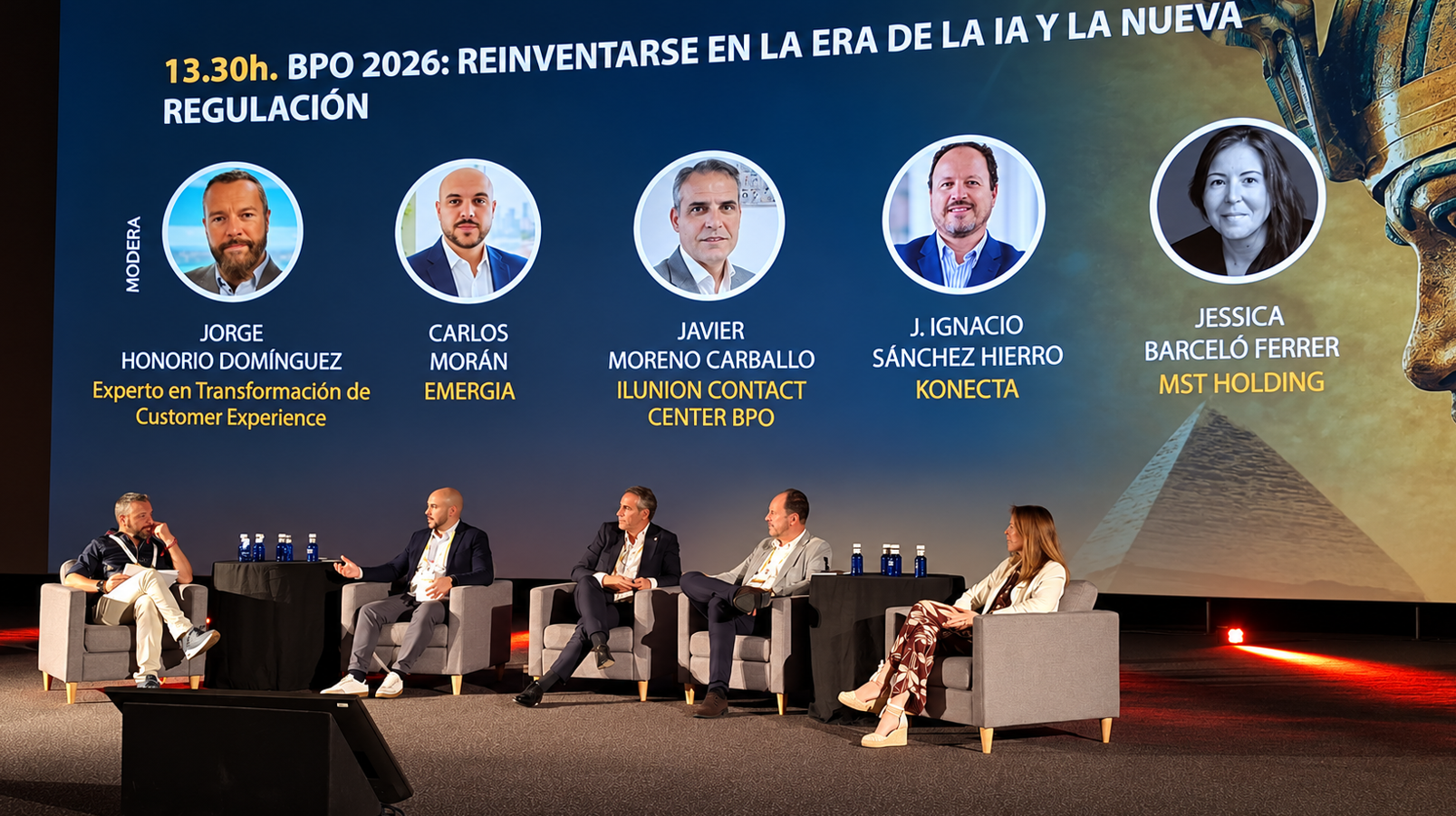
Our CEO participated in Expo Relación Cliente 2026, where she shared her insights into the challenges facing the BPO industry in light of new regulations, artificial intelligence, and digital transformation. During her intervention, she highlighted the expertise of specialized service providers and emphasized how technological innovation can help improve service quality without necessarily increasing operating costs.
The transformation of the BPO industry and the impact of new regulations were among the key topics discussed at Expo Relación Cliente 2026, held in Madrid on October 7–8.
As part of the event, Jessica Barceló, CEO of MST Holding, participated in the roundtable discussion “BPO 2026: Reinventing the Industry in the Age of AI and New Regulations,” alongside representatives from Emergia, ILUNION Contact Center BPO, and Konecta.
During the discussion, Jessica shared her perspective on the role outsourcing companies must play in responding to new regulatory requirements, highlighting the professionalization of the industry, strategic collaboration with clients, and the opportunities presented by digital transformation.
BPO Professionalization: A Competitive Advantage in the Face of New Regulations
One of Jessica Barceló’s key messages was that companies specializing in customer service are well positioned to address regulatory changes.
“Within our industry, we already have a significant competitive advantage because, even before the Customer Service Law existed, we had already professionalized the sector.”
As she explained, BPO companies have been operating under demanding quality standards for years, driven by their clients’ own requirements.
Spain’s new Customer Service Law (Ley de Servicios de Atención a la Clientela, or Ley SAC) aims to extend these levels of professionalization to areas that have traditionally not been subject to the same requirements.
This development may represent an opportunity for specialized providers, whose experience in service management, performance monitoring, and continuous improvement constitutes a significant competitive advantage.
According to our CEO, the new requirements may also create barriers to entry for less-prepared players, further strengthening the value of companies with established structures and processes.
From Operational Service Providers to Strategic Partners
Beyond regulatory compliance, Jessica Barceló emphasized that the new landscape is transforming the relationship between BPO providers and the organizations that engage their services.
Traditionally, many companies approached outsourcing providers with predefined operating models, limiting their involvement to executing specific processes.
However, emerging needs are driving relationships based on greater cooperation and consultancy.
“There is now a genuine spirit of cooperation aimed at overcoming the challenges that the Customer Service Law may create, whether in terms of increased costs or the need to achieve specific quality SLAs.”
This shift represents an evolution in the role of BPO providers, moving from managing operations to actively participating in service design and optimization.
Their industry expertise enables them to help organizations establish quality indicators, identify improvement opportunities, and develop solutions tailored to evolving market needs.
BPO is therefore moving beyond its traditional role as a service provider to become a strategic partner capable of supporting organizations throughout their transformation journeys.
The Customer Service Law Does Not Necessarily Mean Higher Costs
One of the most interesting points raised by Jessica Barceló was her reflection on the financial impact of the new regulations.
Stricter requirements regarding service quality, personalization, and human interaction may raise concerns among companies about potential increases in operating costs.
However, our CEO argued that this scenario does not necessarily have to result in higher expenditure.
“Companies should not be concerned about increased costs as a result of the Customer Service Law.”
The key lies in combining compliance with the new requirements and an effective digital transformation strategy.
Automating certain customer interactions, optimizing processes, and introducing new technological tools can help offset additional operational demands.
This involves identifying which interactions can be handled through automated solutions and which require the involvement of specialized professionals, while consistently maintaining the level of service quality customers expect.
From this perspective, regulation can become a catalyst for service modernization and the development of more efficient customer service models.
Customer-Centric Artificial Intelligence and Automation
During her intervention, Jessica also highlighted the role of digital transformation in addressing the industry’s challenges.
Artificial intelligence and automation solutions can simplify certain tasks, streamline processes, and optimize available resources.
However, the adoption of these technologies must always respond to users’ needs and expectations.
“We should automate those parts of the contact center that can be automated, while ensuring customers receive the experience they expect across every channel.”
This statement captures one of the industry’s greatest challenges: finding the right balance between technology, operational efficiency, and personalized service.
The objective is not to automate indiscriminately, but to identify where technology can deliver value and where human interaction remains essential.
Combining artificial intelligence, automation, and human expertise enables organizations to develop more efficient customer service models without losing sight of the customer experience.
Sharing Experiences to Drive Industry Transformation
Towards the end of her intervention, Jessica Barceló also emphasized the value of the knowledge BPO companies have accumulated through digital transformation projects.
Specialized providers have spent years supporting their clients in modernizing processes, implementing new technologies, and optimizing customer service operations.
This experience represents a valuable asset that can help other organizations address today’s challenges.
Our CEO highlighted the extensive range of use cases and best practices developed by companies across the industry and stressed the importance of sharing this knowledge.
“I believe we need to bring these experiences together and become advocates for the industry so that these best practices can be replicated.”
This perspective reinforces the importance of collaboration among different market players to foster innovation and contribute to the continued evolution of the BPO industry.
MST Holding: Committed to the Future of BPO
Jessica Barceló’s participation in Expo Relación Cliente 2026 reflects MST Holding’s commitment to industry transformation and the development of increasingly efficient, innovative, and customer-centric service solutions.
Her intervention delivered a clear message: new regulatory requirements and technological advances represent an opportunity to strengthen the strategic role of BPO providers.
The future of the industry lies in leveraging accumulated expertise, fostering closer collaboration with clients, and adopting technologies that improve service quality while optimizing resources.
At MST Holding, we remain committed to combining operational expertise, consultancy, technological innovation, and human talent to support organizations throughout their transformation journeys and deliver higher-quality customer experiences.