
KEY ADVANTAGES OF IT OUTSOURCING OR OUTSOURCING OF IT EQUIPMENT AND SERVICES

Whether for economic reasons, due to a lack of qualified staff or to guide their efforts entirely to the business, many companies choose to hire outsourced services or Outsourcing, for the execution of processes and activities related to the technology area. For this reason, today we want to tell you about some of the key advantages of IT Outsourcing or outsourcing of IT equipment and services.

The Society for Resource Management (SHRM), conducted a survey of more than 800 executives from the United States and Latin America from various companies, to find out the main reasons for outsourcing.

The survey revealed that more than 33% of hirings are based on human resources and the possibility of having qualified personnel at a lower cost. In 26% and in accordance with the previous point, the reduction and control of operating costs is due.

Another 23% prefer to focus on meeting business objectives and 18% hire these services to reduce risks and increase efficiency in their operation

WHAT ARE THE KEY ADVANTAGES OF IT OUTSOURCING OR OUTSOURCING IT EQUIPMENT AND SERVICES?

1- Reduce and control operating costs

By outsourcing IT equipment and services, the company eliminates the costs associated with hiring personnel, updating courses, health insurance, taxes and retirement plans, among others. The savings obtained by eliminating the cost of hiring an IT team is interesting.

Often this team does not have all the knowledge necessary to solve problems, so the company incurs eventual expenses for hiring experts to solve problems.

In this way, by hiring an IT outsourcing firm, the company will no longer have to worry about hiring technicians, paying collaborators, labor charges, solving problems, optimizing problems, etc. All this will result in a reduction in costs.

2- Mitigate risks and increase efficiency

By hiring highly experienced, multidisciplinary and certified IT teams and services, you do not improvise, do not waste resources and ensure your operation. Consequently, it improves processes, reducing risks and increasing the efficiency of your company. Risks are always present in any organization.

Market variations, competition, new government regulations, expenses and investments in technologies, all these factors are constantly changing. In IT outsourcing, the service provider assumes and manages the risks.

3- Qualified human resource at a lower cost

Delegating IT management to specialized providers allows companies to have efficient technology platforms and qualified human resources at a lower cost, which translates into increased competitiveness and reduced labor costs.

In the case of software-as-a-service SaaS services, contracting parties can also reduce the costs of licensing programs and acquiring the necessary hardware to manage network tasks when using business applications over the Internet.

This reduction in the number of equipment, such as servers or data warehouses, is reflected in the costs of refrigeration, electrical energy, technological renovation and rental of physical space.

4- Quick access to state-of-the-art technology

Outsourcing allows small and medium-sized companies to have state-of-the-art technological solutions that were previously reserved for large conglomerates, thereby reducing the competitive gap in terms of efficiency and investment. These initiatives include online services on demand and cloud computing.

5- Greater focus on business objectives and strategies

In IT outsourcing, the supplier is the one who manages the team that will develop solutions for the company (manage, integrate and automate IT processes). This ensures that the company is exclusively dedicated to its core businesses, focusing on strategy to stay highly competitive.

You already know the advantages of outsourcing your IT services. Do you want to know how MST Holding is generating value for its clients? Learn about our services at www.mstholding.com


CALL CENTER, THE BASE CENTER TO IMPROVE THE CUSTOMER EXPERIENCE

It has become one of the most important departments for companies and for this reason, in recent years, the call center or contact center sector has continued to grow. Regarding the customer experience, the call center is the most important operations center with which to connect with the customer.

Resilience and adaptation to the new paradigm have made contact centers the strategic point for customer service in the most difficult moments of the health crisis experienced since 2020. All this would not have been possible without the technological developments adopted in these centers, which have made possible the care of thousands of consultations with a greater increase in demand.

Because contact centers are the nerve center of customer service, and consequently, of the customer experience. That is why improving the customer experience from the call center is necessary for all companies.

HOW TO IMPROVE THE CUSTOMER EXPERIENCE FROM THE CALL CENTER?

  •  Minimize waiting time: It is one of the biggest concerns of customers when they need to make a query, resolution time and waiting time. Thanks to the automation of the most repetitive tasks, these waiting times are reduced, as well as the response can be almost immediate. In this way, queries that require humane treatment and actions of greater value are received by telephone service agents.
  •  The customer chooses the channel: omnichannel is already a reality, having different contact channels has become an essential objective of today’s companies, since, in addition to speeding up queries, they allow the customer to contact by the means in which feel more comfortable or adapt to your personal situation. This and other trends will help solve problems more successfully.
  •  Analyze customer feedback: Contact centers receive endless information on a daily basis valuable to customers. With the integration of artificial intelligence solutions, such as text or voice analytics, the agent has help to provide a quality and effective solution. Likewise, this analyzed data represents an advantage over the customer experience map, since it provides a clear vision of the present and future needs of our customers.

Improving the customer experience from a call center is essential for companies, since this nerve center provides the necessary keys to meet customers and encourage loyalty, through an improved service adapted to their needs.

www.mstholding.com

THIS IS HOW THE APPLICATIONS OF VOICE CHANNELS IN CUSTOMER SERVICE HAVE EVOLVED

Customers behaviour has changed in recent years, with greater facilities to compare products and services, even with the appearance of portals dedicated to such comparisons, and thus make the best purchase decisions. This means that factors such as quality or low prices are not so decisive in attracting or retaining customers, but rather the experience of customers and how they interact with brands prevails. For this reason, the applications of voice channels in customer service have evolved so much in recent times.

As Artificial Intelligence tools become more accurate and can engage in natural conversations, they will help improve customer satisfaction and therefore retention. Call processing solutions such as Interactive Voice Response (IVR) can be leveraged to make decisions and take action based on customer insights gained from previous calls. In fact, as several reports already indicate, 76% of customer service professionals prefer voice channels for complex cases. We are going to see the benefits of how voice communication applications can improve customer service, in addition to reducing its costs.

SAVING RESOURCES BY AUTOMATING THE MANAGEMENT OF CALLS

Thanks to automation, it is possible to attend 100% of calls 24/7, reducing waiting time to zero and offering predefined responses to the most common requests. AI is presented as the technology capable of taking on this task, and thus freeing up time from human agents, although without totally dispensing with its presence in this type of task, both to offer the best personalized service and when carrying out activities supervisory or focused on adding qualitative value to the service. So much so, that by 2022, 45% of the repetitive tasks of companies will be automated and/or accelerated, according to Spanish statistics.

OFFER THE BEST EXPERIENCE TO USERS

The customer experience, or customer experience (CX), is considered a decisive factor for business success and represents a competitive advantage for businesses. So much so that the Software Business Techno graphics survey highlights that 53% of European companies have assured that investing in customer experience tools has been one of their priorities during 2021. The IVR service combined with artificial intelligence (AI) directs the automatically calls the right team, department or person to deliver the best response, improving efficiency and speed of response. Thus, one of the main keys for a differential customer experience is satisfied: helping companies to understand and know what the user is like, how they want to reach them and what values they want to transmit to them.

OPTIMIZE BUSINESS INTELLIGENCE

The automation of tasks in a contact center carries with it an important challenge: quickly analyze all the available data to make beneficial decisions for the call center. The business intelligence technology will allow agents to access statistics and user data and convert them into useful information that, later, the IVR will be able to customize to route calls according to the stored data or the new data provided by the customer’s call, directing them directly to the most suitable agent for the resolution of your query, being one of the key applications for customer service.

IVR MANAGEMENT FROM THE CLOUD

The pandemic and the rise of digital services are making the cloud the backbone of new digital experiences. So much so that global cloud revenues will rise to 474 billion dollars in 2022, compared to 408 billion in 2021, as many studies indicate. The implementation of the IVR software is possible without the need for large investments in equipment. In addition, its management is very easy and intuitive from an online control panel that can be accessed from any device. Cloud-based virtual agents help automate interactions between businesses and customers. Powered by AI, by autonomously handling routine and repetitive tasks, increasing the time for agents to spend on handling more complex calls.

www.mstholding.com

HOW TO START A CUSTOMER LOYALTY PROGRAM

In any company or organization is always necessary to attract new customers, but without making the mistake of no retaining the already existent. It is known that it is more difficult to acquire customers than to retain them, also in the economic aspect. That’s why; to carry out a good customer loyalty program is essential.

The idea behind the implementation and adoption of a customer loyalty program is to increase the profit interchanging between a company and their customers. To do this, you have to have the advantages clear in case the plan is implemented. Despite being a big brand, Mango is the perfect example of a successful case in the customer retention.

WHAT DOES A BUSINESS ACHIEVE WITH A CUSTOMER LOYALTY PROGRAM?

According to statistics, with the provision of a rewarding incentive, 75% of customers are more likely to make a second purchase.

COST SAVINGS AND BETTER SALES POTENTIAL

Business owners are aware that only happy and satisfied customers will stick with their brand. Hence, they apply customer loyalty programs. This makes retention a more profitable approach than acquisition.

USER TRUSTED REPUTATION

A company depends on the reputation it builds among customers. Trusting loyal customers to write reviews and make good comments online for your business can boost your brand image. Social media and websites are efficient platforms to market your brand and commercial products, building a trusted reputation for users.

SPREAD THE GOOD WORD OF MOUTH

When you offer rewards and incentives that attract and keep loyal customers, they will surely invite their friends and family. So you’re getting word of mouth to a variety of potential customers when your loyal customers share details with people they know, including family, friends, and colleagues.

KEEP LOYAL CUSTOMERS

Finally, an important benefit of offering a customer loyalty program is that customers will prefer to buy products from your business when they know that incentives await them. Once you offer desirable rewards and rebates to customers for their purchases, they develop a connection with the brand.


8 ELEMENTS TO START A CUSTOMER LOYALTY PROGRAM

 1. Find the best possible name for the program

A good name not only stands out from the rest, it must relate to the needs and requirements of the customers. The basic premise of a customer loyalty program is to arouse their interest and curiosity.

2. Evoke deep meaning in the show and its name

Customers will only opt for a loyalty program if they think it will benefit them. You must make your loyalty program not be seen simply as a tool that chains customers to your business.

On top of that, your customer loyalty program needs to make sense. It must make sense to customers and add value to the business’s shopping experience. You have to choose the right time to present the program and market its benefits.

3. Offer incentives through a variety of customer actions

Making the program effective will depend on how you will reward customers. Will you only reward them for making a purchase? Or will you reward them for other consumer actions such as reviews, social media profile engagement, and content sharing that enhances brand reputation?

You should reward all types of customer participation for a holistic loyalty program, be it promotional offers or discount codes.

4. Plan different types of rewards

For the customer loyalty program, it is best to introduce a dynamic range of rewards and incentives. You have to spark creativity and work on the best possible ideas to include attractive rewards for the most customers, not just discount codes, for example.

A practical example of a reward from a customer loyalty program is the provision of loyalty points. You can let customers accumulate points and then let them choose between free products, movie tickets or privileges through mobile applications.

5. Add value to customer loyalty points

Make it worth the time and money that customers invest in your company. If you think a customer enjoys shopping at your business, you can present them with loyalty points. These are meant to be a marketing tool that drives the customer back to make more purchases. If you provide loyalty points that customers can collect for different types of rewards, customers will visit your store more often.

6. Introduce non-monetary incentives for loyal customers

You don’t always have to provide monetary rewards to customers for their efforts, including good word of mouth and repeat purchases. To help your business grow and keep customers happy in every way, you can also rely on non-monetary incentives. For example, show solidarity with customers because of the difficulties they are going through or get involved in a social movement if you consider it fair.

7. Allow registration through various links

It’s best to promote the benefits and let existing customers know about the loyalty program you’ve introduced. More importantly, you need to provide different enrolment methods within your loyalty programs.

For example, some of the most prominent business leaders in various industries allow customers to enrol customers in the loyalty program through credit/debit purchases.

8. Develop partnerships for inclusive incentives

For example, another company may collaborate with yours to attach their product as an incentive for you to engage with customers through the loyalty program. While customers will see this as a good deed, it will also allow you to form trusted partnerships in your quest to acquire more customers.

MORE PRACTICAL AND EFFECTIVE CUSTOMER LOYALTY PROGRAM IDEAS

As a small or medium business, you need to stay creative in the market. This is because not all growing businesses enjoy a massive increase in sales or profits. In addition, the largest companies have constant financial influence in the market, which allows them to perform great marketing tricks.

Because of that, small businesses have to figure out plans and create customer loyalty programs in a way that helps them stay agile and grow their customer base.

Here are some common forms of leverage that companies use to facilitate the success of customer loyalty programs:

  • Free trial services.
  • Subscription to newsletters (email address).
  • Point systems.
  • Referral programs.
  • Partner programs.
  • Loyalty discounts.

CONCLUSION

In any case, the customer experience must be a priority and a fundamental pillar of a customer loyalty program. You can’t risk creating a customer loyalty program that has no value in the eyes of customers and doesn’t make their buying process interesting or rewarding. No customer loyalty program works overnight to attract customers to the business. But, with the right efforts and incentives in your customer loyalty program, you can retain a large proportion of your customers.

www.mstholding.com

8 TIPS TO TRANSFORM A NEGATIVE EXPERIENCE INTO A POSITIVE

Offering a positive customer experience is one of the most important aspects for the companies of nowadays. However, reversing a bad customer experience remains one of the principal difficulties that the professionals of customer service face on a daily basis. When the service experience goes wrong, a company can risk losing that customer forever.

The key to success is having referral strategies to remedy the situation and to get back customer trust and loyalty. To demonstrate how to turn unsatisfying experiences into satisfying ones, eight members of the Council of Young Entrepreneurs shared with Forbes their top recommended ways to improve customer service.

HOW TO TRANSFORM A NEGATIVE EXPERIENCE

1.    Active listening

 “This doesn’t just mean being quiet while they talk. Really listen to them. Ask questions when he retells the story. Agree with them when they mention something your company did wrong. It’s okay to disagree with them, but always remember that missed expectations cause most customers to feel upset. So even if you don’t agree with them, acknowledge that your company didn’t adequately communicate expectations (or didn’t meet them). Obviously, offer a solution where you can, but if you don’t start by listening, the rest will be in vain.” – Mark Daoust, Quiet Light, Inc.

2.    Capture your experience with a poll

 “It’s best to first capture the customer experience internally with a survey or other means of communication with your company, especially one that goes directly to customer support. Suppose you can contact the customer before they leave a negative review in the App Store or online. In that case, you will have the opportunity to resolve the complaint and make amends in private rather than airing your dirty laundry in public. This effort on your part will also make the customer feel more positive about your business because they will see that you care about their experience and are willing to do whatever you can to make sure they are satisfied.” – Tyler Quiel, Giggster.

3.    Ask the customer for help

«Is there anything more frustrating than a bad customer experience? They’re dissatisfied, he’s disappointed, and they all get caught up in the debris in between. The only truly effective solution I’ve found to solve a customer’s problem is to ask them to help solve the problem. Don’t try to guess what might make them happy, ask them. Let them know that you are so interested in their satisfaction that you need their input and thoughts to find the best possible solution to their problem. Then thank them for it: Acknowledge them online, send them a thank you card, give them a little token of appreciation. Not only will you have a customer for life, but word of mouth about your care and dedication to customer happiness will spread like wildfire, and your customer base will continue to grow.” – Ashley Sharp, Dwell with Dignity.

4.    Set up automated customer service checks

 “In my hospitality business, unfortunately we deal with customers from time to time who leave unhappy. The first and most important thing to do with every customer is to contact them soon after their experience. We configure automatic texts for our clients. These usually reach the customer before they go to the public review sites with anything negative. If their time with us wasn’t up to par, they’re usually always responsive, which activates someone in our company who’s specifically there to manage our guest experience. Our Director of Hospitality will contact the guest and invite them back with something courtesy. Then our staff will meet with the client when they return to ensure that the service is perfect. This additional attention captivates them and turns them around.” – Michael Sinensky, WeShield

5.    Offer a “compensation” promotion

 First, solve the problem. Then, offer a compensation promotion. The main reason why the customers leave is a loss of trust. You can go a long way to resolve it simply by addressing the problem they faced and letting them know of your solution in the future. Of course, to turn them into a paying customer again, offer them an incentive to try your product or service one more time. That could be a discount or promotion that de-risks their investment and gives them more confidence that you’re working hard to do the right thing for them and provide more value.” – Firas Kittaneh, Amerisleep Mattress.

6.    Answer inmediately

“The faster you can respond, the more your customer will feel like you’re available and willing to listen. Letting a complaint sit can escalate it and convey that you have more important things to do than talk to your customer. If it’s not always possible to respond to all complaints immediately, you can use complaint management software to help get the issue to the right people as quickly as possible. Most of this software includes an auto-scaling feature that prevents complaints from stagnating. I also always tell my employees not to let the customer be the last person to respond. No company makes 100% of their customers happy all the time, but you can still be the last to respond to show that you’ve done everything you can to help.” – Shu Saito, AllFilters

7.    Be proactive and open

“The best way to change a negative experience is to be proactive and open. For example, if a customer complains that your product isn’t working, apologize, ask what went wrong, and offer to replace their product. If you’ve ever had to deal with a bad customer service experience, you know it sticks with your memory and can really affect how you feel about a brand. You want to be transparent and open about how you will fix the problem. Not only is this the best way to engage and retain customers, but it’s also a great way to keep them up to date on what’s happening in your business and the industry as a whole.” – Kevin Ryan Tao, NeuEve

 8.    Let them know you have done changes

 “Once a business has incurred the sunk costs to “acquire” a customer, the goal is to continue to earn revenue from that customer in future business. If the customer has a bad experience, future business could be in jeopardy. To help repeat customers who have had a bad experience, it’s important to make sure the customer knows they’ve been heard and that the business cares. As such, it is important for the customer to know that processes and procedures have been changed and “controls” have been put in place to ensure the problem never occurs again. This shows how seriously the company takes the customer experience and resolves any doubts in their mind that they will have a different experience in the future. A customer you’ve retained will be twice as loyal and likely to recommend you!” – Bill Mulholland, ARC Relocation.

www.mstholding.com

DO YOU HUMANIZE OR DIGITALIZE?

After these last two and complicated years, we can affirm that something is changing for the better and that, at least, something good the pandemic has brought to us. I am referring to the urgent concern in companies to improve the experience of their customers and their workers, putting them at the center of the organization, and listening with great interest to what they have to tell us.

It is going from being reactive to using business intelligence to transform data into knowledge. What our customers care about, how we can best develop the talent of our workers, what makes them proud to be part of our company, and what makes our customers “fans” of our brand.

To keep going on this path and be prepared, not only for this current need but also for the future, we are already seeing how many companies have begun to lead from the executive committee the actions that allow them to continue growing and innovating in solutions. These help them better understand what their customers and employees need, putting both at the center of their new customer service strategy and at the center of the organization. Today, technology companies provide business solutions to organizations to make them more competitive.

That way they can offer the best experience to their customers and “empower their workers”. This way, they can offer a more humanized service, regardless of the channel that they choose to contact with their company. How we do it? From the concept to the action. The path to generate an excellent 360º value starts here:

1.   Business intelligence: Converting data into knowledge.

2.   Artificial intelligence: Preparing the companies for the future.

3.   Learning machine: Converting data into intelligence decisions.

4.   Customer experience: Compelling all the information that the companies have of their   

      customers exploiting it, to obtain the highest profitability of it and improve the customer 

      experience with the company.

At this time, it is a priority to use disruptive and flexible technology for each project and solutions that help identify what each client needs, making “the voice of the client” the key to being able to offer more value and provide them with the best possible experience.

Technology helps us to humanize the customer service

Nowadays we see how technology has been put into the customer’s hands which are every day more demanding and a better customer experience:

*Be present in the different digital channels and require attention for any channel, anytime, anywhere.

*Receive 24/7 attention waiting to solve their doubts, requests or queries in a more agile way and in a first contact.

*Be more aware of what you consume and what it costs you.

*Work with a company that inspires a lifestyle and values ​​that each time acquires greater prominence, such as: sustainability, transparency, respect, diversity…

This is how today we have a consumer who needs technology to connect with brands, but who demands a more humane treatment. For this reason, today more than ever the humanization of customer service is necessary. For this reason, it is important that both company and employee have the right technology to help them humanize the service to their customers, offering them more personalized solutions.

We all want to feel special and unique when we talk with the customer service of a company, and we hope that the experience with it is excellent and capable to generate us a feeling of “pride of belonging” to it.

When we talk about using “voice of the customer” solutions, this information can be obtained in two ways:

In the first case, when the customer contacts our company through the contact center. These are the “voice of the customer” listening solutions that will help us collect all the information that the customer offers us when they contact us by phone. They will allow us to turn these conversations into very valuable information, which will help us identify why the client calls us, what they need, what we can offer them to improve their satisfaction and/or retain them.

Likewise, it will allow the integration of all this information with the company’s CRM, giving more power and the necessary tools to the employee who attends to the client, having all the information required when adding more value in real time to the client. In this way, thanks to technology, a more humanized and personalized customer service and attention is achieved, turning them into “fans” of our brand.

In the second case, the customer can contact us through the web or social networks. If we have a “voice of the customer” solution, we can turn this data into key information for our business. Once this information is completed in the company’s CRM, it will allow it to centralize it and relate it to each contact or each client and, in turn, be available for the employee to respond quickly and agilely to the needs of our customers, offering them the best possible experience thanks to technology.

Therefore, if we return to our initial question: do you humanize or digitize?

We see that technology, far from dehumanizing our company, will give us the opportunity to obtain more information from our clients. In this way, the service is humanized and the employee is “empowered” to provide much more value and, therefore, generating more business, more customers and more happy employees for the organization.

www.mstholding.com

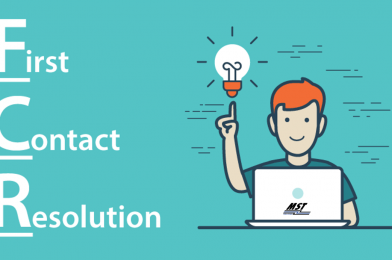
HOW TO CALCULATE FIRST CONTACT RESOLUTION (FCR)?

First Contact Resolution (FCR) is a percentage measure of a contact center’s success rate in answering customer inquiries the first time they are made. It’s a metric often confused with First Call Resolution, which goes by the same acronym.

While both measure the same, First Contact Resolution does it in all contact center channels, while First Call Resolution is only for the voice channel.

WHY IS FIRST CONTACT RESOLUTION IMPORTANT?

First contact resolution is now seen by many as the best measure of contact center efficiency, as few organizations use talk time as a metric to guide advisors. This is because it can encourage negative behaviours as advisers can start rushing over the phone.

Therefore, organizations are turning to FCR to assess not only the effectiveness of advisors, but also the processes and technology behind them.

In fact, if you use FCR in combination with Average Handling Time (AHT) and divide the metrics by your most common contact reasons, you can highlight your most inefficient customer journeys.

THE FIRST CONTACT RESOLUTION FORMULA

 The traditional formula for FCR is: Queries resolved on first contact / the total number of contacts x 100. The problem comes with how you get the data to input into this calculation.

While the calculation is simple, how do we know that a contact has actually been resolved? How can we track that?

We could ask advisors to confirm with the contact whether or not it has been resolved. But that might encourage negative behavior or customers might realize at some point afterward that something isn’t quite right with the resolution, despite previously saying they were happy with it.

So maybe we can track repeated calls over a certain period of time. But will the interaction be long enough? And maybe the customer will call for a different reason?

Therefore, these two methods are not true RCF calculation methods. A better method of calculating FCR is to send the customer a summary of the interaction a few days after the initial contact. If the client is not satisfied and the case is not “truly resolved”, they can reopen the case and the FCR can be tracked that way.

While first contact resolution is becoming more prevalent in the contact center “metric mix”, it will not be the only measure and it will adjust to all of their requirements to offer a good customer service.

www.mstholding.com

CHATBOTS: TRENDS AND KEYS TO THE NEW DIGITAL ENVIRONMENT

The digital acceleration that has occurred during the period of lockdown has been extraordinary, and has made it possible to activate new trends around the world that will persist and even grow once the COVID-19 crisis is over. The response of brands to the pandemic has advanced to seven years the digitization of interactions with customers and the supply chain. To accelerate the recovery and make easier the transition to the new economic reality in Spain, an effort will be necessary on the part of companies, which can approach this effort from three horizons: resilience, return and reinvention.

In an accelerated digital evolution context, Chatbots are the new assistance formula to the customer which we must bet on. Chatbots are not designed to be implemented casually, they rather require prior work and study that allow seamless implementation and in line with the brand’s objectives. Some of the keys to its success are as follows:

Give it personality. A Chatbot with its own personality and that can maintain a fluid conversation with users is an essential aspect of its success. A good conversation flow that allows for clear dialogue will increase with the satisfaction rate, as well as the bot’s ability to complete the interaction from start to finish.

Design in tune with the user. Put the user at the center of your strategy: why would your customer need to use the Chatbot? What flow of interactions will follow? What are their main questions and problems with your service or products?

Destroy data deposits. It is equally important to be able to not only obtain valuable information from the interactions with the users, but also to analyze this data and to extract conclusions. We must break down the silos of information, structure the data and take advantage of it to continue enriching our Chatbot

Continuous learning. Implementing a chatbot is not a process with a beginning and an end: it is a constantly evolving process, and your bot will never stop learning. Each interaction with users will provide you with very valuable information that you must take into account when continuing to improve it. Test your solution, analyze, modify… and repeat.

At MST HOLDING we have the latest technology in Chatbots and Virtual Assistant, contact us at www.mstholding.com.

Omnichannel: The imperative to sell more

In a context of market change, the buyers have different expectations and they demand omnichannel, that is, unified experiences through different channels, and sellers, for their side, must follow the rhythm of the change they are constantly facing.

What are the challenges and priorities that establish the design on omnichannel?

 The real situation is that it is estimated that only 14% of the retailers in Europe have achieved a full omnichannel, despite the fact that they consider it a priority, and a big majority are in the process of development. 100 % online stores are the most important competition for these retailers, that face, among others, the challenges of the security and data base privacy in their omnichannel implementation. In addition, the leaders of the omnichannel leave behind /put aside the benefits/profits in a short term, that is, sales, in favor of their customers loyalty.

Omnichannel consists in offering a unified experience to the customers in all contact points and the customers wait for the brands to be on top of their expectations and that they offer an omnichannel service.

But omnichannel isn’t only for the retailers, of course. Developing omnichannel capacities has never been so important for the B2B buyers than how it is today.

B2B buyers have been incorporating actively digital channels in their buying process, putting aside the sellers that have not developed yet these channels.

Which factors can determine the success of omnichannel?

 Capacity

Many companies find it hard to develop and integrate the right skills, people and teams. We must look for a tool that makes it possible to merge, evaluate and group customer data obtained through various channels.

Product category

Different product ranges require different channel and customer strategies. Companies should be able to determine the channel preferences of customers in their own segment of products and services and be able to forecast the development of channel preferences of their customers. On the other hand, a comparison with the competition is also relevant.

Channels

Another question companies should ask themselves when testing their omnichannel strategy is if they are using the right channels. The term “channel” can include apps, calls, store pickup, chatbots, QR codes, etc. It’s also important here to define a cross-channel customer journey and then link the various channels to enable cross-selling. A constant analysis of the channels, including their strengths and weaknesses, can be considered a success factor.

Customer data

Customer data must be recorded at touch points, combined and used for campaigns. The challenges are access to customer data and potential legal restrictions on personal data. Data is crucial to offer a good omnichannel experience, but in turn, consumers/customers are not always in favor of providing it. The success factors in customer data are the definition of the customer journey and successful segmentation of target groups by channel.

Code

Omnichannel excellence requires the fast and constant use of new digital technologies. Therefore, companies should ask themselves if they are making optimal use of digital technologies. This requires, for example, a review of all backend and frontend processes. The challenge is to forecast the acceptance of new technologies by customers.

Periodically survey to customers

Collecting and analyzing customer feedback to learn and apply suggestions to improve the service we offer should be an integral part of the omnichannel experience. Understanding the customer journey at every stage and on every channel, while also identifying needs that can be improved to deliver better results, translates into a success factor.

Supply chain

Omnichannel sales are linked to a flexible, transparent and complex supply chain. Therefore, companies must ask themselves if their existing supply chain can meet these requirements or if it needs to be adapted to meet the requirements of the omnichannel strategy (for example, by real-time visualization of the availability of products or decentralized returns management). The success factors are the technical support of the supply chain, and its control.

Cost analysis

Companies must achieve potential savings with the omnichannel strategy through channel-specific incentivation. From the outset, omnichannel implementation is concerned about its cost, due to the complexity that integrating new technologies with existing ones may have, but this does not have to be the case with an agile and flexible integration tool that accepts pre-existing technology.

Corporate culture

The success of omnichannel requires a corporate culture that is right to innovation and that overcomes siled thinking. Success factors are pilot projects with cross-functional teams. On the other hand, clear communication of the omnichannel strategy and the omnichannel KPI are also part of the success.


If you want to know how MST Holding can help you develop an omnichannel strategy in your business, do not hesitate to contact us.

www.mstholding.com


Complaints and how to convert them into your ally to create a satisfied customer

Experience proves that the good relationship between customer and company isn’t always long-lasting, since incidents can take place that weaken it and even end up breaking it and complaints are part of this system.

When a customer complaint happens, a situation arises that requires delicate treatment, as a way to provide a solution to the customer that doesn’t end with the lost of it, or even worse, with the ”word of mouth effect”and loss of prestige.

The received treatment of the complaints from the customer service centers, is going to be essential for it to be used as a precedent for customer loyalty, or the loss of value of the company against future customers and/or in the market.

We must never lose the point of view that a customer is a human being and, therefore, when we are faced with a complaint, human nature itself must be considered. In other words, they need to feel that they are listened to, and that their opinions, concerns or doubts are valued, giving them their deserved recognition. To do this, the responsible staff for managing this type of incident must have a large dose of tact, flexibility and reflection so that, in this way, we can make the client forget that such dissatisfaction has occurred.

The first essential and basic point to be considered by the company for the correct management of complaints is to provide contact channels for the customer to report incidents. This will serve as an opportunity to improve both services and products, carrying out successful marketing campaigns: both telephone and email customer service must be clearly reflected in all commercial communications.

  • Connecting with the customer: prior to the conversation with the customer, it is necessary to plan the tools that are going to be used. That is, what words will we use so that the client feels that the agent listens to him and understands him and also, that he values ​​his concerns, and that he empathizes with him.
  • Understanding the problem and proposing solutions:  Against the complaints of the customers, the continuous training of the staff in charge of dealing with them is very important. That is, employees must have all the resources available to be able to provide a variety of solutions to customers, thus giving them the option of choosing the one that best suits their needs. Only in this way, we avoid the deterioration of the company’s image. A conversation should never be closed without the complaint having been resolved.
  • Compensation for inconvenience: For the most part, the customer who makes a complaint expects compensation for the inconvenience caused. But also, in reality it is the best way to solve incidents that happen due to complaints. That is, the unsatisfaction that has given rise to the complaint must be transformed into a solution with which the client wins, surprising him with an unexpected and favorable response to his interests and needs. There are a variety of options when it comes to achieving this objective, which also depends on the sector of the organization and the type of customer. In general, gift cards, discount vouchers, movie tickets, exclusive offers, etc. are sent by email or SMS, and in real time. In short, the customer must be compensated with gifts that can satisfy him, since strengthening him is as important as thanking him for helping to improve the organization.

To sum it all, we can conclude that the resolution of requests, complaints, claims and suggestions is also part of the trust that a company gives, and not only through good experiences. In short, the customer service center will be capable of transforming the majority of customer complaints into opportunities for improvement, facilitating the loyalty of contacts considered difficult through the creation of bonds of trust towards the company, between the agent and the customer.

www.mstholding.com