
BPO and Contact Center for HVAC with integrated AI
We combine technical specialization in HVAC, service governance, and a technology ecosystem based on artificial intelligence to manage customer service, technical support, and after-sales with operational efficiency and continuous improvement.
Request an assessment of your operating model
* Required fields.

Outsourcing customer service and technical after-sales in the HVAC sector requires much more than a traditional call center.
The technical complexity of equipment, extreme seasonality, and the direct impact of each incident on customer experience make a specialized HVAC BPO model essential, focused on resolution rather than contact volume.
At MST, we operate as an HVAC Contact Center and BPO partner, governing customer service, technical support, SAT management, and associated back-office end-to-end. Our approach is designed for manufacturers, official technical services, and installers who need operational efficiency, service control, and a consistent customer experience even during peak cold and hot periods.
Customer service and specialized HVAC technical support
HVAC customer service cannot be managed as a generic service.
Each contact requires technical knowledge, diagnostic capability, and an understanding of the operational impact of incorrect classification. For this reason, our HVAC Contact Center is staffed by profiles specifically trained in technical environments.
We combine customer service and HVAC technical support in a single operational flow, allowing us to resolve incidents from the first contact or prepare for technical intervention with the highest possible precision.
- Receipt and technical classification of notices.
- First contact diagnosis (technical FCR).
- Remote technical support.
- Multi-channel and after-hours support.
A good first contact conditions the entire performance of the technical service.


With more than 30 years of experience in Contact Center BPO and Customer Support
MST operates in sectors where operational stability and brand reputation are critical.
The MST model for Contact Center and BPO for HVAC
If you manage customer service, technical support, SAT or back-office in the HVAC sector, at MST we help you identify operational risks, inefficiencies, and improvement opportunities without impacting the service.
We evaluate your current HVAC Contact Center and BPO model with a technical, operational, and business vision.
- Operational diagnosis without obligation.
- Identification of quick wins.
- Actionable recommendations.
Start governing your HVAC after-sales with data, not assumptions.

Customer / Partner
Contact Channels
Voice
Chat
Web
Social
B2B
MST Intelligence Layer (AI)
Bots
Automation
RunTicketing
AI Classification
RunWiki
Agent Assist
eAlicia
Quality Audit
TAI
Sentiment Analysis
Business Analysis
Agent / Human Operations
Specialised Support
Reduced
AHT
Improved
FCR
Customer Systems











Customer ERP
Event Resolution + Continuous Improvement
Services and KPIs governed in HVAC Operations
The following table summarizes the main operational services in the sector and the KPIs that govern each one, allowing for an understanding of the MST model at a glance.
- Services × KPI – HVAC Sector
| Services / Operational use cases | SL | FCR | FTFR | TTR | Reworks | NPS | Commercial activation |
|---|---|---|---|---|---|---|---|
| Customer service and notice reception | |||||||
| Advanced technical diagnosis (1st contact) | |||||||
| Remote technical support (remote resolution) | |||||||
| Technical visit and WO management | |||||||
| Coordination with official and multi-brand SATs | |||||||
| Technical back-office (warranties, spare parts, documentation) | |||||||
| After-hours services and on-call duties | |||||||
| Cross-selling (maintenance, extensions, services) |
- Critical KPI managed
- KPI monitored to support control
Customer Journey in HVAC: service governance by phase
HVAC after-sales outsourcing often fails when it is limited to diverting contacts without controlling diagnosis, technical visits, or service closure.
The operation is governed by clearly differentiating before, during, and after the technical event, as each phase has different risks and metrics.
- Customer Journey × Operational Governance
| Phase | Main objective | Key interactions | Control focus |
|---|---|---|---|
| Before | Prevention and preparation | Commissioning, warranty activation, technical inquiries | FCR · Backlog · SLAs |
| During | Resolution and containment | Breakdowns, diagnosis, remote support, technical visit | FTFR · TTR · Reworks · NPS |
| After | Complete closure and loyalty | Warranties, follow-up, maintenance contracts | TTR · NPS · Close the loop |
| Value moment | Value generation | Maintenance, extensions, premium services | Assisted conversion · Perceived quality |
Technical diagnosis and WO management to maximize FTFR
In the HVAC sector, service efficiency directly depends on the quality of the initial diagnosis and Work Order (WO) management.
An incomplete or incorrectly classified WO generates unnecessary visits, second interventions, and SLA penalties.
MST governs technical diagnosis and WO from the first contact, capturing model, symptoms, installation context, and probable parts using specialized systems like RunTick.
- Correct technical classification of the incident.
- Precise WO construction.
- Complete preparation of the technical visit.
- Increase in FTFR (First Time Fix Rate).
Properly preparing the visit is the fastest way to reduce costs and improve CX.

Management of technical visits and coordination with HVAC SAT
Managing HVAC technical visits is not just about scheduling appointments.
It requires prioritizing real emergencies, assigning the right technician, and coordinating information between customer service, SAT, logistics, and back-office.
We work with official and multi-brand SAT networks, ensuring complete traceability and operational consistency regardless of the manufacturer’s network model.
- Smart scheduling based on urgency and location.
- Coordination with official and multi-brand SATs.
- Reduction of failed visits.
- Control of resolution times (TTR).
Every well-managed visit avoids hidden costs and future reworks.
HVAC remote technical support and non-presential resolution
Many HVAC incidents can be resolved without a technical displacement.
HVAC remote technical support allows for parameter adjustment, resets, or guiding the user through simple interventions, reducing unnecessary visits.
MST integrates remote resolution as a structural part of the operational model, with specific KPIs and complete closure of the technical event.
- First contact resolution.
- Reduction of unnecessary visits.
- Improvement of TTR and NPS.
- SAT capacity release.
The goal is not to answer more calls, but to resolve each technical event better.
Experience the benefits of outsourcing your Contact Center
Turn challenges into opportunities with MST Holding
HVAC technical back-office and warranty control
The HVAC technical back-office is key to correctly closing the event and avoiding subsequent reworks.
Warranties, spare parts, documentation, and follow-up require operational rigor and traceability. Our model integrates the back-office as a structural part of the service, not as an isolated administrative task.
- Warranty and spare parts management.
- Technical documentation and closures.
- Post-intervention follow-up.
- Reduction of technical backlog.
An incomplete closure today is a certain problem tomorrow.
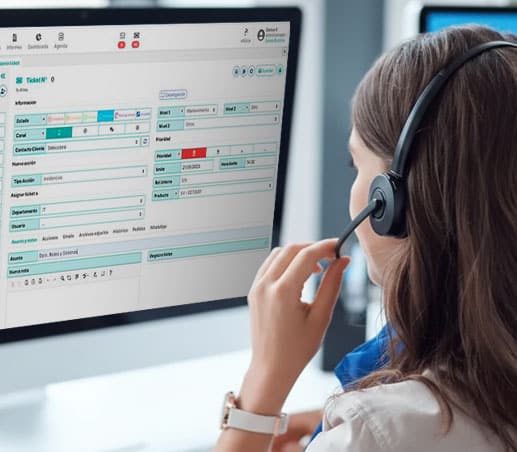
Quality, AI, and scalability in HVAC operations
Quality in an HVAC Contact Center is not guaranteed by manual audits alone.
With TAI (Transformation Artificial Intelligence) we analyze 100% of interactions to evaluate diagnosis, technical knowledge, and process compliance.
This analysis feeds AI-powered wikis, allowing the operation to scale during peak cold and hot periods without losing technical consistency or quality.
- Automatic quality audit.
- Reduced learning curve.
- HVAC seasonality management.
- Scalability with control.
AI applied to after-sales turns knowledge into a competitive advantage.
HVAC BPO focused on efficiency, loyalty, and growth
A well-governed HVAC BPO model not only reduces operational costs but also turns after-sales into a lever for loyalty and business.
Every well-resolved interaction strengthens customer trust and opens up value opportunities.
MST activates cross-selling of maintenance contracts, warranty extensions, and premium services only at moments of real value.
- Improved NPS and CSAT.
- Reduced costs per technical event.
- Recurring after-sales revenue.
- Increased customer lifetime value.
When the service works, the business grows naturally.
Data security and processing
Operations in HVAC involve the processing of large volumes of sensitive customer and transaction information.
At MST, we ensure:
- Secure data processing in European private data centres.
- Strict compliance with GDPR and the European regulatory framework, including the AI Act in the use of artificial intelligence.
- Full traceability of interactions and automated processes.
- Integrated compliance control in operations and AI systems.
Technology partners:





Discover all our Contact Center and BPO services
At MST, we offer specialized Contact Center solutions for the HVAC sector, designed to improve KPIs, optimize costs, and ensure comprehensive service governance.





We analyze your Customer Service operation for HVAC
If your organization manages customer service, after-sales, appointment management, or back-office in the HVAC sector, we can help you identify risks, frictions, and opportunities for improvement.
The first step to improving the service is to understand it in depth.
- Outsourcing customer support in automotive.
- Outsourcing of Contact Center and back office.
- Multichannel and multilingual operations.
- Service governance focused on business KPIs.
Outsourcing is not delegating contacts; it is ensuring control of the service.
NOW is the time to transform your operation!
* Required fields.
Frequently Asked Questions about Contact Center and BPO in HVAC
Why is technical diagnosis at first contact so critical?
Because it conditions everything that follows. An incorrect diagnosis generates poorly defined WOs, visits with incorrect parts, and unnecessary second interventions. In HVAC, the problem is rarely with the technician, but with the quality of the prior diagnosis. A good first contact increases FTFR, reduces costs, and improves customer experience.
What real impact does FTFR (First Time Fix Rate) have on operations?
FTFR is one of the most important indicators in the sector. Every point it drops means more visits, more logistical costs, more SAT saturation, and worse CX. Improving FTFR does not only depend on the technician, but on the quality of the WO, the initial diagnosis, and the information available before the visit.
How can a technician be prevented from having to go twice due to lack of parts?
By properly preparing the visit. At MST, we structure the WO from the first contact, capturing symptoms, exact model, installation context, and probable parts. This allows the SAT to be prepared and maximize resolution on the first visit, both in official and multi-brand networks.
What role does WO management play in service efficiency?
The WO is the basic unit of efficiency in HVAC. If it is incomplete or poorly classified, the entire system fails. With specialized ticketing systems like RunTick, MST governs the WO from start to finish, allowing for the measurement of FTFR, escalations, closure times, and reworks with real metrics.
Can HVAC incidents be resolved without sending a technician?
Yes, many simple incidents can be resolved remotely: pressure adjustment, purging, equipment reset, or replacement of basic elements. Guided remote technical support reduces unnecessary visits, improves TTR, and increases customer satisfaction. The challenge is not doing it, but doing it judiciously and with proper closure.
How are scheduling and customer location managed?
Scheduling is not just about making appointments. It involves prioritizing real emergencies, assigning the right technician, and working with complete location and context information. Poor scheduling generates failed visits, re-contacts, and penalizes NPS. MST governs the schedule as part of the technical event, not as an administrative task.
Does the model work with both official SATs and multi-brand networks?
Yes. The MST model is designed to work with both scenarios. This requires neutral systems, clear SOPs, total traceability, and a well-constructed WO. Service consistency does not depend on the type of SAT, but on the governance of the model.
How are extreme cold and heat peaks absorbed without losing quality?
With predictive planning, operational elasticity, and prepared backups. MST combines stable teams with temporary reinforcements that reduce their learning curve thanks to AI-powered wikis and automatic quality control. Additionally, controlled rotation of profiles between cold and hot campaigns is managed.
How is technical quality guaranteed when temporary staff are brought in?
Quality is not left to chance. TAI analyzes 100% of interactions to detect diagnostic errors, lack of knowledge, or protocol deviations. This information feeds AI-powered wikis and training plans, allowing temporary profiles to maintain homogeneous quality levels.
What does TAI contribute in a technical environment like HVAC?
TAI doesn’t just audit calls. It analyzes diagnostic quality, technical knowledge, process compliance, and customer sentiment. This allows for identifying error patterns, adjusting training, and preventing recurring incidents before they become reworks or penalties.
How is after-hours and weekend service managed?
Breakdowns don’t adhere to schedules. MST operates on-call services, weekends, and after-hours through specific shifts, bots, and structured mailboxes that prioritize real emergencies and ensure continuity of technical service in critical scenarios.
Does cross-selling make sense in an HVAC technical service?
Yes, but only when the service is well resolved. Commissioning, the first breakdown, or a successful remote resolution are natural moments to activate maintenance contracts, warranty extensions, or premium services. Forcing it earlier breaks trust and penalizes the experience.
What differentiates MST from a traditional technical contact center?
MST is not limited to handling notices. It governs the complete technical event: diagnosis, WO, visit, closure, and continuous improvement. The focus is on reducing unnecessary visits, increasing FTFR, and turning after-sales into a lever for efficiency and value.
When does it not make sense to outsource HVAC after-sales?
When the goal is solely to reduce cost per contact without adopting a governance model, technical metrics, and quality control. In HVAC, outsourcing without structure often multiplies reworks and hidden costs. MST does not operate under that approach.

Our Group
Environmental Commitment
Quality
Sectors
Memberships


Since 1992 | © 2026 MST Holding | All rights reserved.